Antica Barbieria Colla Promotion: a gift for you in September

Here comes a new promotion from Antica Barbieria Colla, a gift to start the autumn with enthusiasm after the well-deserved summer holidays. From today to next October 16, by purchasing three products from our catalog it will be possible to receive the cheapest for free!

September marks the actual start of the new year for many, an important appointment to take back the reins of one’s life and achieve one’s goals. A month that pushes us to give our best, not only to prepare for the arrival of autumn, but also to rediscover beauty and style after relaxing – and perhaps a few too many revels – of the summer holidays. And what better way to recognize your own image in the mirror, and always show yourself elegant and fascinating, if not by taking advantage of the products of Antica Barbieria Colla?

The promotion that Antica Barbieria Colla wanted to inaugurate the autumn is truly indispensable: by choosing three products from the entire catalog, including the renewed Almond Oil Hard Shaving Soap, it will be possible to receive the least expensive as a gift.

But which combinations to choose, among the many available? Whether it’s hair, shaving or beard care, here are some tips from Antica Barbieria Colla for a complete and effective treatment.

Haircare: ideas for medium to long hair

After the short cuts of the summer, also to face the heat of the season, in the autumn many will choose to go back to more generous lengths. But which products to choose to stimulate growth and, above all, keep the hair always soft and shiny?

Almond Shampoo: ideal for deeply nourishing hair without weighing it down, thanks to its fatty acids and good vitamin E content, a real panacea for both the hair and the skin;

Herbal Conditioner: the combined action of mallow, fenugreek and nettle to strengthen the hair, rebalance the scalp and the production of sebum, all for a soft and knot-free hair;

Capsicum & Menthol Lotion: one of the most popular products of Antica Barbieria Colla, created by Franco Bompieri after a trip to Sicily. Its refreshing action brings relief to the skin and, at the same time, stimulates hair growth.

Shaving: perfect even on the go

September is also a period of business appointments, of travels to forge new strategic partnerships, of trips to launch new projects. And in such a busy month, many will also feel the need to shave while traveling. But how?

Shaving bowl: elegant and made of polished stainless steel, it is the perfect solution for those who want to combine the pleasure of traditional shaving with a small and easy-to-carry size;

Natural bristle shaving brush: made of pig’s natural white extra bristles, it offers excellent resistance and a long lasting. And it is perfect when packing, to always carry it with you;

Almond Oil Hard Shaving Soap: the unmissable product of Antica Barbieria Colla, one of the most loved ever, today with a new, more moisturizing formulation and also ideal for sensitive skin.

Beard: the style that never sets

Finally, let’s have a look also at the beard, for a style that never sets. And for those who have decided to shave it during the summer, autumn is the perfect time to make it grow back. But how do you manage the early stages when opting for a short, sculpted beard?

Darkwood Beard Shampoo: rich in magnesium, it gently cleanses the beard and helps to soothe irritation, typical of those with a short beard;

Jojoba Oil Beard Conditioner: rich in vitamin E, this conditioner protects the skin, stimulates its regeneration and improves beard growth. The chemical composition of jojoba oil is in fact very similar to human sebum, for a rebalancing action;

Bitter Orange Beard Dry Oil: it softens, hydrates and restructures the beard, giving it shine. Also and especially perfect for short styles, when the beard tends to be harder and bristly.

Use and brief history of the electric razor

After talking about the straight razor and the safety one, an article dedicated to the electric razor could not be missing.

Electric razors have always been essentially of two types:

  • foil razors;
  • rotating razors.

Foil razors are suitable for those

  • having a sensitive skin;
  • having relatively thin hairs;
  • preferring a close and daily shave.

Rotating razors are ideal for those

  • having normal to hard skin;
  • having a full beard with thick, long hairs growing in different directions;
  • who don’t shave every day.


Both types have a common ancestor: the father of the electric razor was in fact Jacob Schick, a former colonel in the US army.  In the early 1910s, while recovering from an injury suffered during a gold exploration, he found it difficult to shave and began to think of a razor with a shaving head driven by a flexible cable and powered by an external motor. This prototype, however, was far from practical and was rejected by manufacturers.

After the First World War which forced him to interrupt his project, Schick progressively improved his original idea and in 1928 he created the first real electric razor, then patented in 1931, which enjoyed great commercial success: in just under a decade he arrived to sell about 1.5 million pieces.

However, a series of technological innovations led in a short time to overcome Schick’s invention, based on blades that moved back and forth, as in a normal hair clipper.

Shortly after the Remington Rand Corporation introduced the first foil razor, which used oscillating blades covered by a thin layer of metal and guaranteed greater comfort; the design principle of today’s foil razors has remained the same.

Among the leading manufacturers of foil razors today are the German company Braun, founded in Frankfurt in 1921 by Max Braun, and the Japanese Panasonic, born in Osaka in 1918 by the will of Konosuke Matsushita.

Vintage foil razor


In 1939, Philips created the rotating razor, equipped with a head with an internal rotating blade that shaved the hairs captured by a fixed external protection. This mechanism is also still in use today and is particularly appreciated for shaving difficult areas such as the neck and chin.

Even today Philips is one of the largest manufacturers of rotating shavers.

Vintage wireless rotating razor


The first wireless razors appeared already in the 1940s, such as the dynamo one that we keep in our shop: it worked without electricity and without batteries simply by pulling a wire, but starting from the 1960s with the advent of rechargeable batteries it became more of a collector’s item.

The electric razor has certainly revolutionized the world of shaving: it is practical, fast and less irritating to the skin, but undoubtedly with its use, the rituality and craftsmanship of the ancient art of barbering that Antica Barbieria Colla aims to preserve is lost.

Shaving and sun: how to take care of the skin

As we all know by now, with summer on its way it is very important to adequately protect the skin from the sun’s rays, which can cause wrinkles and spots to appear, annoying erythema and painful burns.

Those who usually shave their face or head and cannot therefore count on the natural protection offered by hair should observe some precautions, let’s see which ones.

  • Remember to avoid exposing yourself directly to the sun immediately after shaving in order not to cause the skin further stress in addition to that of the razor; shaved skin is also generally lighter and therefore more sensitive to sunlight. So, better shave the day before.
  • Use a specific sun product for shaved skin, which should be applied both before sun exposure (for example at home before going out) and during exposure with a certain frequency, especially if the formula is not water resistant. In addition to shielding from UV rays, sunscreen helps to counteract skin dehydration caused by the sun.
  • For those with a shaved head, as the skin in this area is particularly delicate, it’s a good rule to use a sunscreen with at least spf 30 even in the city; it would also be good to protect yourself with a hat, especially if you spend a whole day outdoors.
  • Pay particular attention to the nape of the neck, where the skin is very sensitive and you tend to sweat more in the heat: make sure you apply the cream also in this area and when possible keep it covered.
  • Even those who shave their face should use a high protection product, or at least suitable for their skin type, and possibly with a non-greasy formula, in order not to favor the onset of pimples and irritation.
  • After sun exposure apply a moisturizing and soothing product to both the skin of the face and head.

You just need to follow these few simple tips to fully enjoy the sun and avoid unpleasant consequences, even with shaved skin.

This is why Antica Barbieria Colla for this summer season has created a specific sun product for those who shave their face and/ or head, with spf 30 protection and extremely delicate: in its formula deliberately not waterproof to be lighter and easily tolerated by shaved skin there are aloe, almond and wheat germ oil for the specific calming, softening and soothing properties that give life to a light and enveloping texture.

After Shaving Sun Cream spf30

The safety razor

Some time ago in this blog we published an article on the history of shaving and the straight razor; today we would like to continue where we left off talking about the safety razor, that is a T razor with interchangeable blades.

This type of razor was conceived by King Camp Gillette, an American inventor and entrepreneur who in 1895 had the idea of ​​producing a device that was economical, did not require sharpening and strop and had the right size to shave the face of an adult man. In fact, it seems that Gillette hated the freehand razor, considering it dangerous, as well as a waste of time.

Having worked as a young man for a manufacturer of disposable packaging, he had the opportunity to reflect on the advantages of interchangeable products and thought of producing cheap and replaceable blades to attach to a simple handle.

In 1901 Gillette founded the American Safety Razor Company, later renamed the Gillette Company, and patented his razor. If in the first year, 1903, sales were disappointing (just 51 razors and 168 blades), in just over a decade they reached 450,000 razors and 70 million blades per year, also thanks to the massive advertising campaign to make the new product known; with the First World War then, the company was commissioned about 3.5 million razors and 32 million razor blades for American soldiers. The success was such that the company opened branches in Canada and Europe and the effigy of Gillette’s face began to appear on all packages.

The T razors that are found on the market today are distinguished mainly on the basis of the materials in which they are made (from plastic to metals for those of higher quality), for the type of design and for the type of headpiece.

The main designs are:

TTO (Twist To Open) or Butterfly – turning a pin at the end of the handle opens the head halfway (like the wings of a butterfly) and allows to change the blade;

two-pieces – the cutting head unscrews from the rest of the razor in order to change the blade;

three-pieces – the upper part of the razors unscrews from the handle and it’s divided into 2 pieces (the head and the guard, where the blade lies upon); this type of razor is the easiest to clean, but changing the blade may initially be more difficult.

With respect to the type of headpiece we distinguish:

the closed comb – there’s a protection bar that stretches the skin facilitating the sliding of the blade and reducing the risk of cuts and irritation. This is therefore suitable for beginners, those with sensitive skin and those who shave frequently;

the open comb – instead of the bar we find a sort of toothed comb that allows the blade to apply greater pressure. This makes the razor very aggressive, suitable for those with experience, a very hard beard and who don’t shave too often;

adjustable razors – the allow to adjust how much the blade protrudes thanks to a pin placed at the end of the handle, thus varying the degree of aggressiveness of the razor. This model is also more suitable for expert hands.

The safety razor  has progressively replaced the straight one for reasons of hygiene, safety and practicality: it is a good compromise between shaving efficiency and comfort and the blade protruding only slightly from the head, while coming into close contact with the skin and cutting the hair at the level of the bulb, cannot sink into the skin and cause deep cuts.

We hope Mr. Gillette won’t mind, but in our shop where we have been performing the traditional Italian shaving for over a century, we definitely prefer the use of the good old straight razor, albeit with an interchangeable blade.

Shaving soap VS shaving cream

In our shop, the ancient craft of shaving has been handed down since 1904; faithful to the Italian tradition, our barbers have always used the classic shaving soap and, since 1945, its cream version, whose recipe is still the original one. But let’s see their features in more detail.

Both are specific products aimed at preparing the face skin for shaving, moisturizing and protecting it from the aggressive action of the razor; they also allow to soften the hair and facilitate the sliding of the blade.

The Soap has a solid consistency and is packaged in a greaseproof paper; its formulation is based on Almond Oil, an ingredient with a strong moisturizing and softening power, particularly appreciated by those with sensitive skin, and with a delicate fragrance.

During production, the soap still liquid is poured into the appropriate molds and then left to solidify for a time that varies according to the humidity in the air and the time of year.

Shaving soaps solidifying in our laboratories


To be used, the soap has to be lathered, an operation that may not be easy if you are not familiar with it, especially if the water used is very hard.

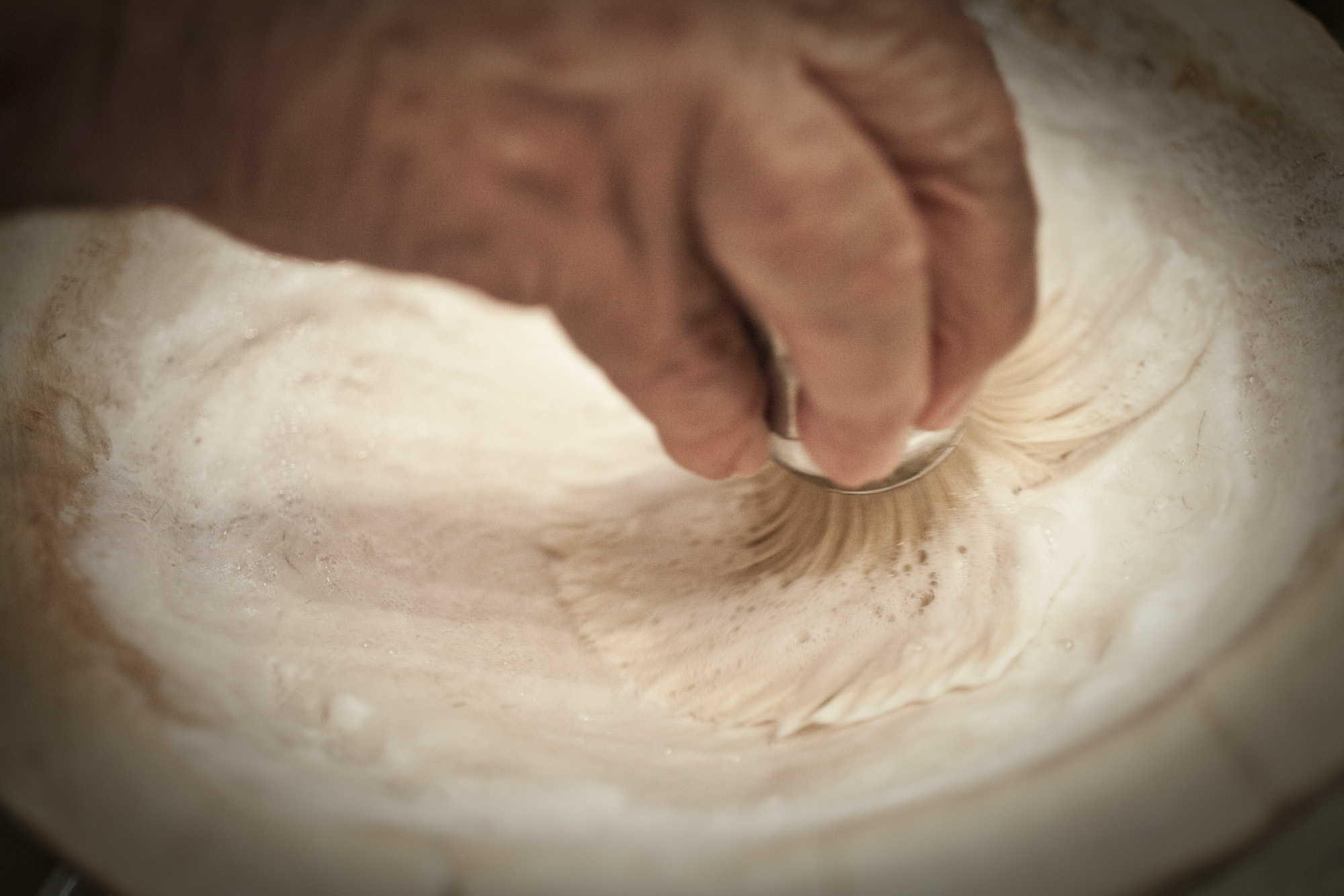
To lather the soap, you need to prepare the brush first: fill a bowl with hot water and leave the brush to soak for a few minutes, in order to soften the bristles.

After this time, take the brush and squeeze it to remove excess water: the bristles have to be moist, but not dripping.

Then you can proceed by rubbing the brush on the soap with circular movements until you start getting some foam. At this stage we recommend paying attention to the quantity: a little soap is enough to produce the foam necessary for a complete shave.

Now it’s time for the so-called saponata (which means lathering): with the brush you apply the foam on the face and perform a series of continuous circular movements so that the foam rises further until it becomes a white, thick and creamy lather.

Once this is done you can start shaving.

Let’s now talk about our Shaving Cream: it has a soft consistency and is packaged in a jar; the formulation is the same as the soap, therefore based on Almond Oil.

Its production takes place by emulsifying the ingredients to form a cream, which is then transferred to the jar in a still semi-liquid form. The jar is then closed and the product is allowed to cool and solidify for a short time before handling the package again.

The Shaving Soap in Cream has to be lathered too, but given its consistency the operation is simpler and more immediate: you can in fact take the necessary amount of product and put it in a shaving bowl, and then lather the foam with a damp brush. .

After applying the product on the face, with repeated circular movements we will obtain a compact and homogeneous lather.

Have a good shave!

Its Majesty, the straight razor

The custom of shaving goes back thousands of years: it seems that already in prehistoric times the first men removed the hair of the beard one by one with their hands, and then moved on to using small shells as tweezers and sharp stones or bone fragments as razors.

It was probably the ancient Egyptians who introduced the real razor, a bronze or copper blade with a very sharp curved shape, which could only be handled by experts.

A further step forward came with the Romans who, as some finds that have come down to us show, made razors in iron, obsidian and flint.

Over the following centuries, these tools underwent minor improvements, but we have to wait until the end of the 17th century to witness the birth of the straight razor, also known as a barber’s or folding razor, since the blade folds inside the handle.

The first razors of this type were made in Sheffield, England. Here, around the middle of the 18th century, Benjamin Huntsman devised a procedure that allowed to obtain a particularly hard type of steel (later known as Sheffield steel), suitable for the manufacture of sharp blades which were later mounted on decorated handles; his method was also quickly adopted by the French and Germans and the latter became renowned manufacturers of straight razors, so much so that they began to talk about Solingen razors to indicate those produced in the homonymous area located in North Rhine-Westphalia.

The main parts of the straight razor are:

handles or scales: the two main parts that make up the handle to protect the blade once the razor is closed, made of various materials including wood, horn, ivory, ivory, tortoise shell and mother-of-pearl;

pivot: the pin on which the narrow end of the balde rotates;

tang: the upward curved metal end of the narrow part of the blade beyond the pivot which acts as a lever to help raise the blade from the handle. One or two fingers resting on the tang also help stabilize the blade while shaving;

shank: the narrow support piece between the tang and the main blade which sometimes features decorations and the brand stamp. The top side and the under side of the shank can sometimes exhibit indentations for a more secure grip;

shoulder: the curved lower part of the main blade from the shank to the cutting edge;

heel: the point where the shoulder joins the cutting edge;

toe: the endpoint of the cutting edge at the front of the blade, opposite to the heel;

stabilizer: a thick strip of metal running transversely at the junction where the main blade attaches to the shank. It cab be double, single single, or can be absent in some razor models;

back or spine: the arched, non-cutting top of the blade;

cutting edge: the cutting part of the blade opposite the back;

point or head or nose:  the other free end of the blade, at the opposite end of the tang on the spine.

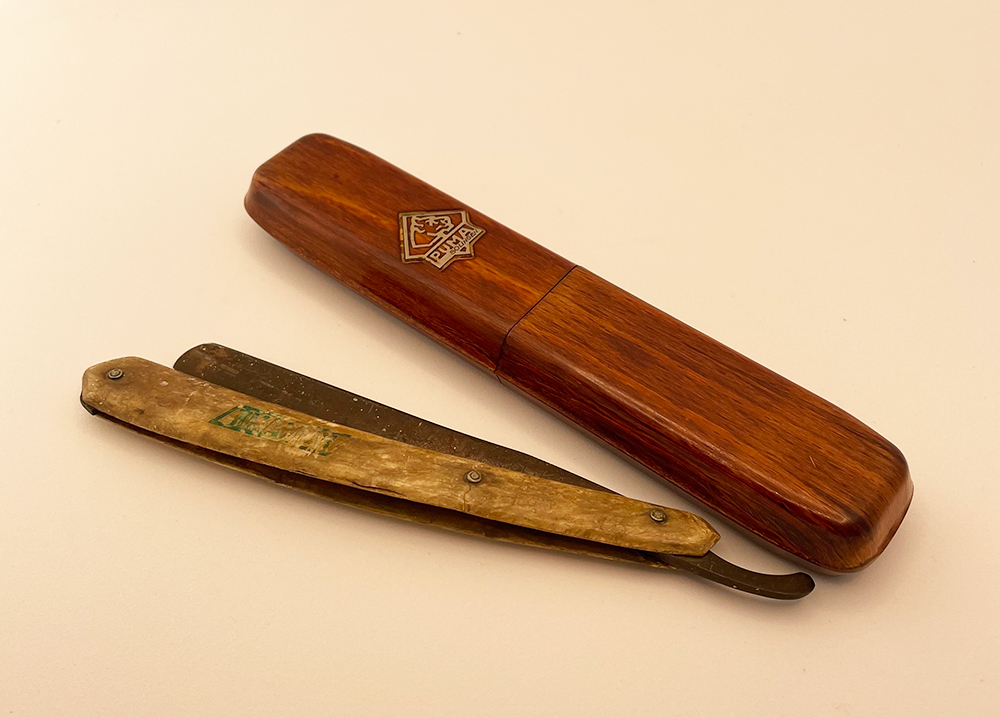
Straight razor, private collection Antica Barbieria Colla


Straight razors were widely used throughout the 19th century and in many countries until the mid-20th century; however, as they require more attention during shaving and careful maintenance (periodic sharpening on stone and use of strop to keep the blade clean and sharp), they have progressively been replaced by other types of razors.

However, there are still today a certain number of enthusiasts and both artisanal and industrial producers in Europe (especially in Germany), North America and Asia (particularly in Japan).

Shaving brush: badger or pig?

Antica Barbieria Colla beard and hair care line was not created for commercial purposes, but to perform the services we have been offering for over a century.

Every time I introduce the line to retailers, customers, agents, distributors, professionals, friends, relatives etc., I keep explaining this concept, surely turning out repetitive.

It’s very important that this is understood because it’s the underlying idea of all our products.

We have to start from here to understand what I am now going to say about our natural bristle shaving Brush.

I’ve got any kind of criticism, remark, question and judgment about this product.

So since it’s finally possible, I’ll explain in detail its value and the reasons behind our choices.

As you can read in its tagline in the dedicated section of our website, this is a professional, handmade brush; its ultimate purpose is to ensure the highest performance during the shaving service.

It’s a countertrend choice compared to what it’s usually found in the market, where most brands have badger bristle for its brushes, which are nice, shining, soft and as I am quite often told “very charming”.

Although I do agree that aesthetic is important and badger is very fascinating, for us the pig bristle brush was the one and only to be launched in the market.

Why?

Because the pig bristle is firm, compact and resistant and it is the one we have been using daily at Antica Barbieria Colla for over a century.

Moreover:

1) The skin needs to be massaged (a lot) before shaving.

We start from a hand massage with the Almond Oil and Aloe Pre-Shave Cream, but then we have to keep massaging with the Almond Oil Shaving Cream and the brush, and you’ll agree with me that hands pressure is different from the bristles one, especially if they are soft and tend to open like the badger brisles; this is why we use pig bristles, which are firm, compact and resistant as pointed out above.

2) When we spread the soap, the brush knot has to be as much ergonomic as possible in order to adapt to the face shape; besides, the firmest bristles are the shortest one.

For this reason, the tip of the knot gets manually cut by our artisans in a round shape which will allow our barbers to reach every part of the face and for us it’s between 3.5 and 6.5 cm tall, not more.

3) Pig bristles last over time if treated right.

They don’t weaken nor lose their resistance, so the brush lasts at least two years; by this time, if any problem is encountered due to production, Antica Barbieria Colla replaces the brush for free.

Nevertheless, to ensure your brush a long life you have to take care of it according to the instructions.

Before using it for the first time, leave it to soak in water so the bristles absorb it and get soft and elastic.

A clarification: online you can find some videos where my father, Franco Bompieri, says to leave the brush in the water for 3 days; to be honest, I have to publicly admit Franco tended to magnify things in his stories, 6 to 12 hours are enough for the brush to be ready.

Being it a handmade product, it has a slight adjustment period and it might lose some bristles the first times, but this is going to happen less and less frequently as using it.

Lastly, for the sake of clarity: it’s an expensive product, but its price is due to its features and value.

We presumed to sell a different brush from the accessories usually found in the market; one can often fall into the trap of comparing it to alike items which are maybe cheaper just because they are synthetic and  industrial.